
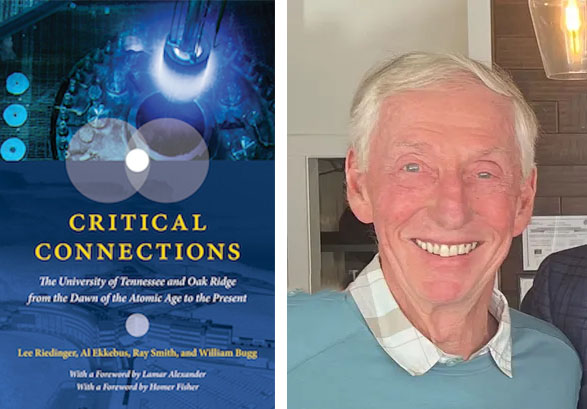
Retired University of Tennessee Physics Professor Lee Riedinger and his book about the history between UT, ORAU and Oak Ridge.
Lee Riedinger, Ph.D., wrote a book about the history of the connection between the University of Tennessee, Knoxville and Oak Ridge because he felt a responsibility to tell the story.
“I’ve been around UT for a long time,” said Riedinger, who is partially retired after serving on the faculty of the UT Physics Department for 49 years. “I just felt the need to write this down because you see leaders of institutions come and go. When they come, they usually do not understand the history of the organization. Too often, leaders reinvent the wheel because they don’t understand where the current status came from.”
Riedinger spent five years writing Critical Connections: The University of Tennessee and Oak Ridge from the Dawn of the Atomic Age to the Present, published in 2024. His co-authors are Al Ekkebus, former outreach leader for neutron science at ORNL; Ray Smith, Oak Ridge city historian, formerly of Y-12; and William Bug, former head of the Physics Department at UT.
ORAU has been a vital link in the connection between UT and Oak Ridge since the sunsetting of the Manhattan Project after World War II, Riedinger said on an episode of Further Together, The ORAU Podcast.
A key figure in the early connections between UT and Oak Ridge was William G. Pollard, Ph.D., founder of the Oak Ridge Institute for Nuclear Studies (now ORAU). Pollard was a nuclear physicist who researched gaseous diffusion extraction of Uranium-235 at Columbia University in New York during the Manhattan Project.
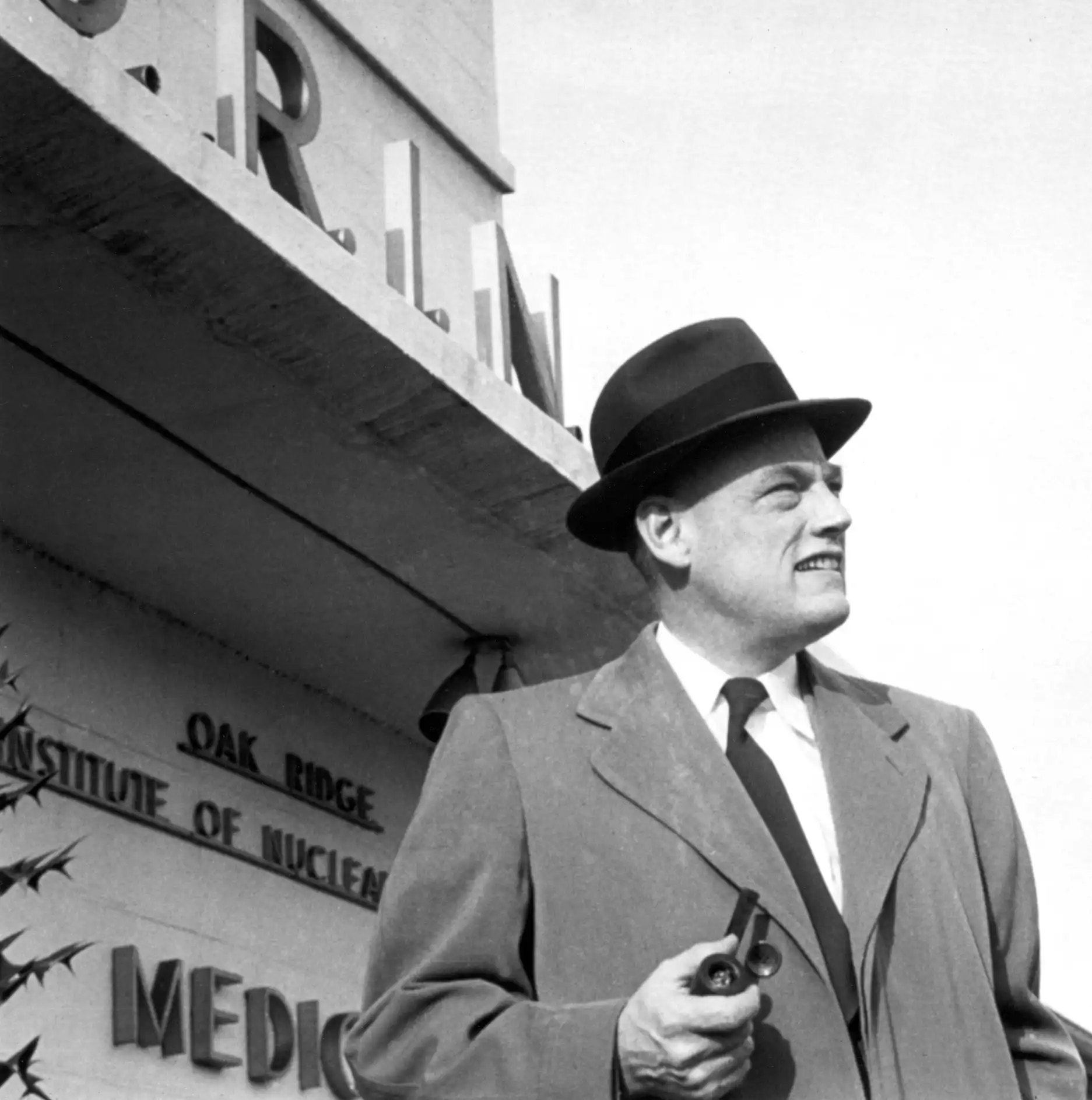
UT Physics Professor William Pollard, Ph.D., founded ORINS (what became ORAU) to continue research efforts in the Oak Ridge, Tenn., area after WWII.
ORAU and creation of the national lab
After the success of the Manhattan Project, the United States military was unsure what to do with the laboratory facilities—Clinton Laboratories in Oak Ridge—that had been created to support it. Did the government need to continue funding a laboratory for a project that had ended? If the laboratory closed, the scientists and engineers who worked there were likely to leave the region.
A suggestion over dinner in September 1945 changed the course of Oak Ridge’s history and its economy.
Robert Bortz, who was head of the chemical engineering department at UT, convened a dinner for Katharine (Kay) Way. Three years earlier, Way had been teaching physics at UT when she was recruited to join the Manhattan Project at the University of Chicago, where she worked under future Nobel Prize winner Eugene Wigner in the metallurgical laboratory.
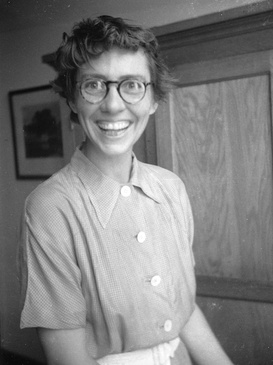
Katharine “Kay” Way. Image courtesy AIP Emilio Segre Visual Archives, Wheeler Collection, via ORNL Review.
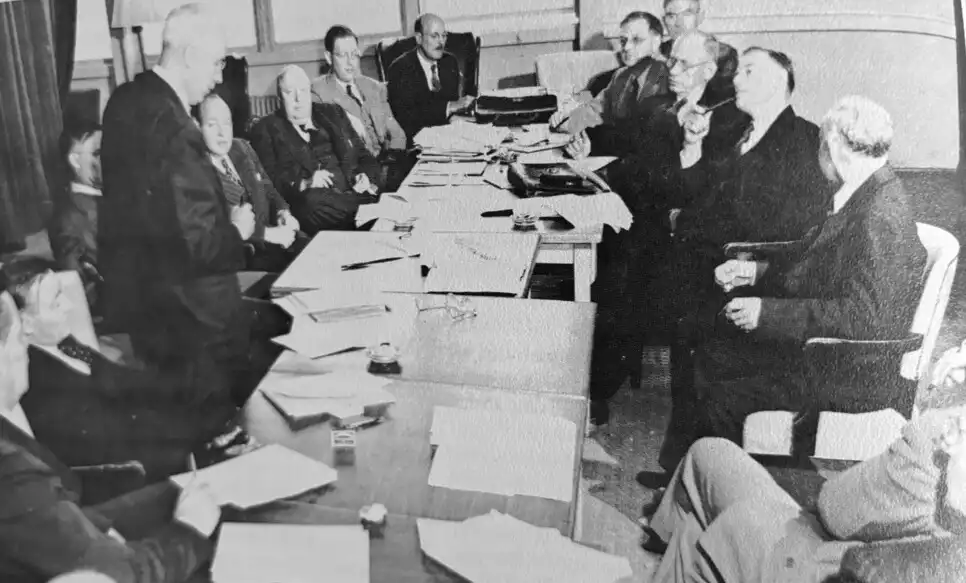
Pollard and Kenneth Hertel, head of the UT Department of Physics, attended that dinner where Way explained that some of the universities in the Chicago area, where Argonne National Laboratory is located, were talking about forming a consortium to access the laboratory. Way wondered if the same thing could happen with the laboratory in Oak Ridge.
Way’s suggestion ultimately led to the formation of the Oak Ridge Institute of Nuclear Studies as a university consortium in 1946.
“Bill Pollard picked that ball up, ran with it, and formed a consortium of 14 universities, and that was officially kicked off in October of 1946,” Riedinger said. Pollard led ORINS, and the Atomic Energy Commission, a federal agency charged with managing the national laboratories, was created in January 1947, and Pollard got ORINS approved by the AEC.
ORAU and the University of Tennessee
ORINS had a role in keeping Manhattan Project scientists in the region by helping the University of Tennessee create doctoral education programs.
Riedinger says many of the Manhattan Project scientists and engineers had been pulled out of graduate school to work on the project. Following the Allied victory and the end of World War II, these scientists and engineers were inclined to go back to their respective schools to finish their doctoral work.
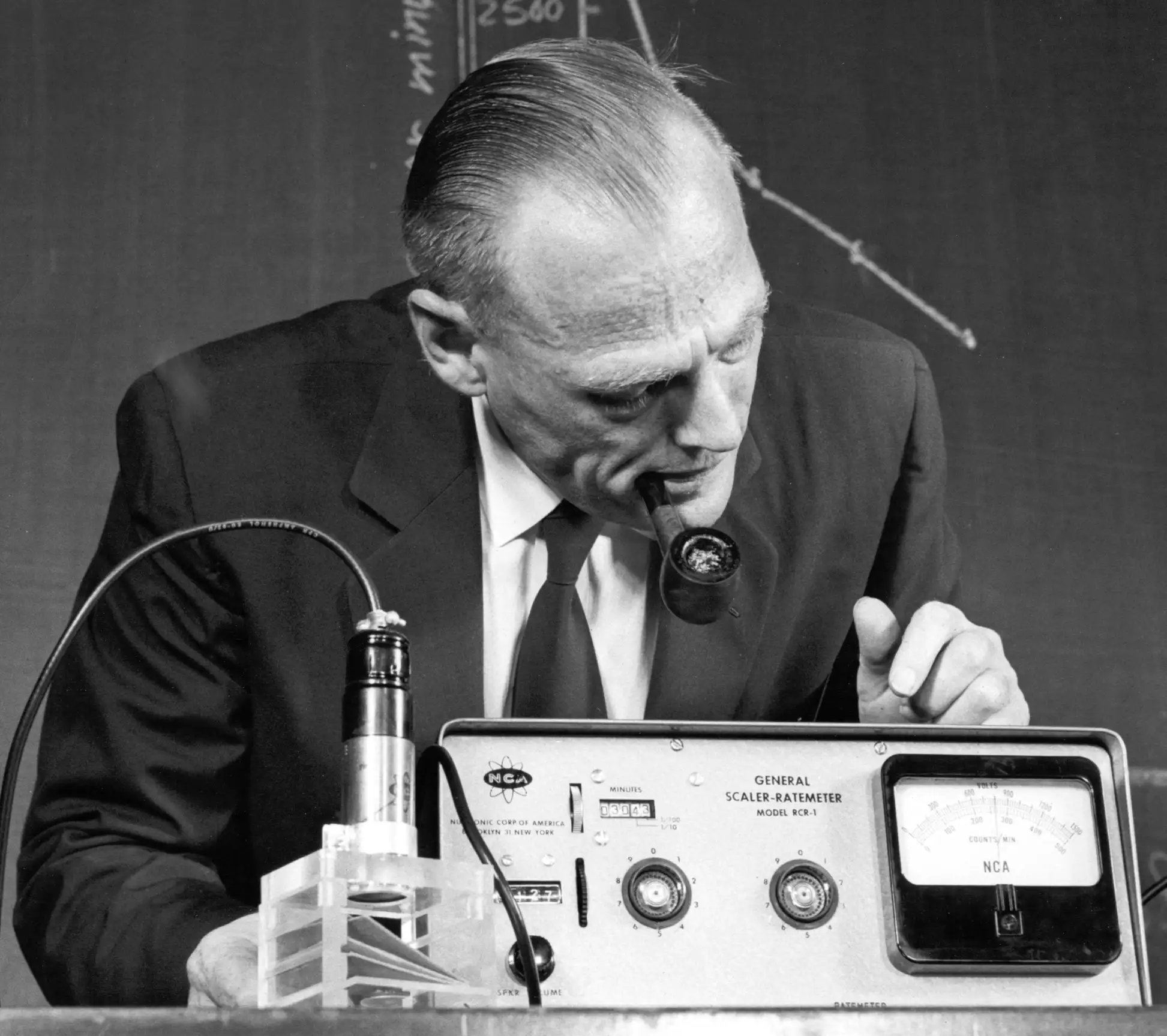
William Pollard, Ph.D., pictured with a radiation detection instrument
This was 1944, and UT was not considered a very advanced university at the time. It was a land grant school with a primary focus on agriculture. There were no doctorate-level education programs.
“UT created its first Ph.D. programs – chemistry in 1945, physics in 1946 – primarily to serve Oak Ridge,” Riedinger said. “Offering these programs enabled Manhattan Project Workers to stay in Oak Ridge, get their Ph.D. degrees locally and continue their work at three plants [K-25, X-10 and Y-12],” Riedinger said.
Pollard led the effort to expand UT’s educational offerings and taught one of the first physics courses on site in 1945, Riedinger said.
ORAU and UNISOR
On the podcast and in his book, Riedinger tells the story of how ORAU and its member universities combined resources to build an isotope separator at ORNL around 1970.
Joe Hamilton, a professor of physics at Vanderbilt University and Riedinger’s mentor in graduate school, led the idea to build the isotope separator with funds contributed by a dozen universities, including Vanderbilt and UT.
The University Isotope Separator at Oak Ridge (UNISOR) was installed at the Oak Ridge Isochronous Cyclotron, an accelerator for producing short-lived radioactive isotopes. “The separator that was built by these universities enabled you to separate out the newly created radioisotopes and study their nuclear properties,” Riedinger said.
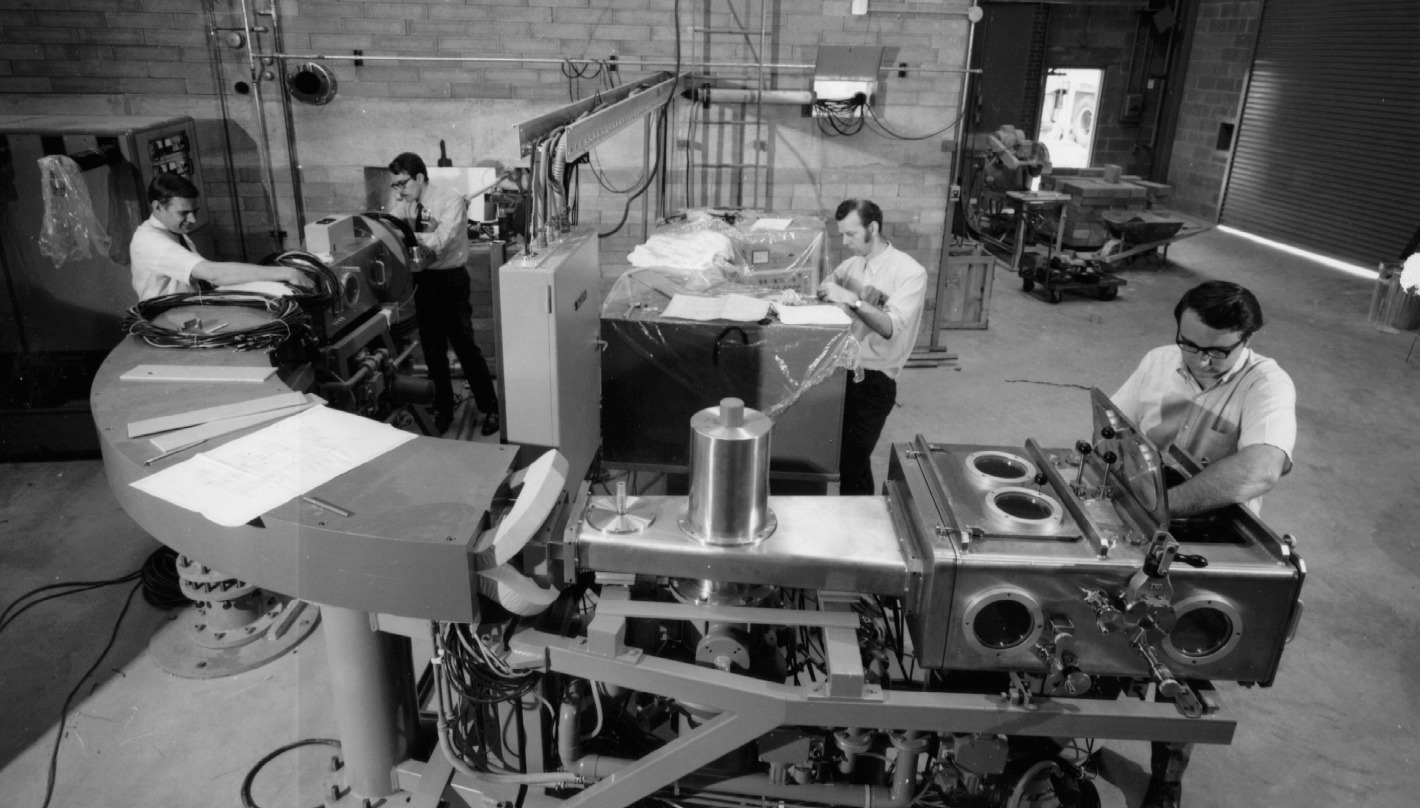
Historic image from UNISOR at an early stage of installation.
ORAU was the administrative glue that held this together and provided management of the facility. UNISOR helped researchers at the partner universities better understand radioactive decay, isotope identification and nuclear structure.
“It was a huge success,” Riedinger said. “That was the first user facility at Oak Ridge National Lab, and maybe I think the first at any U.S. National Lab.” Today, there are at least a half dozen user facilities at ORNL.
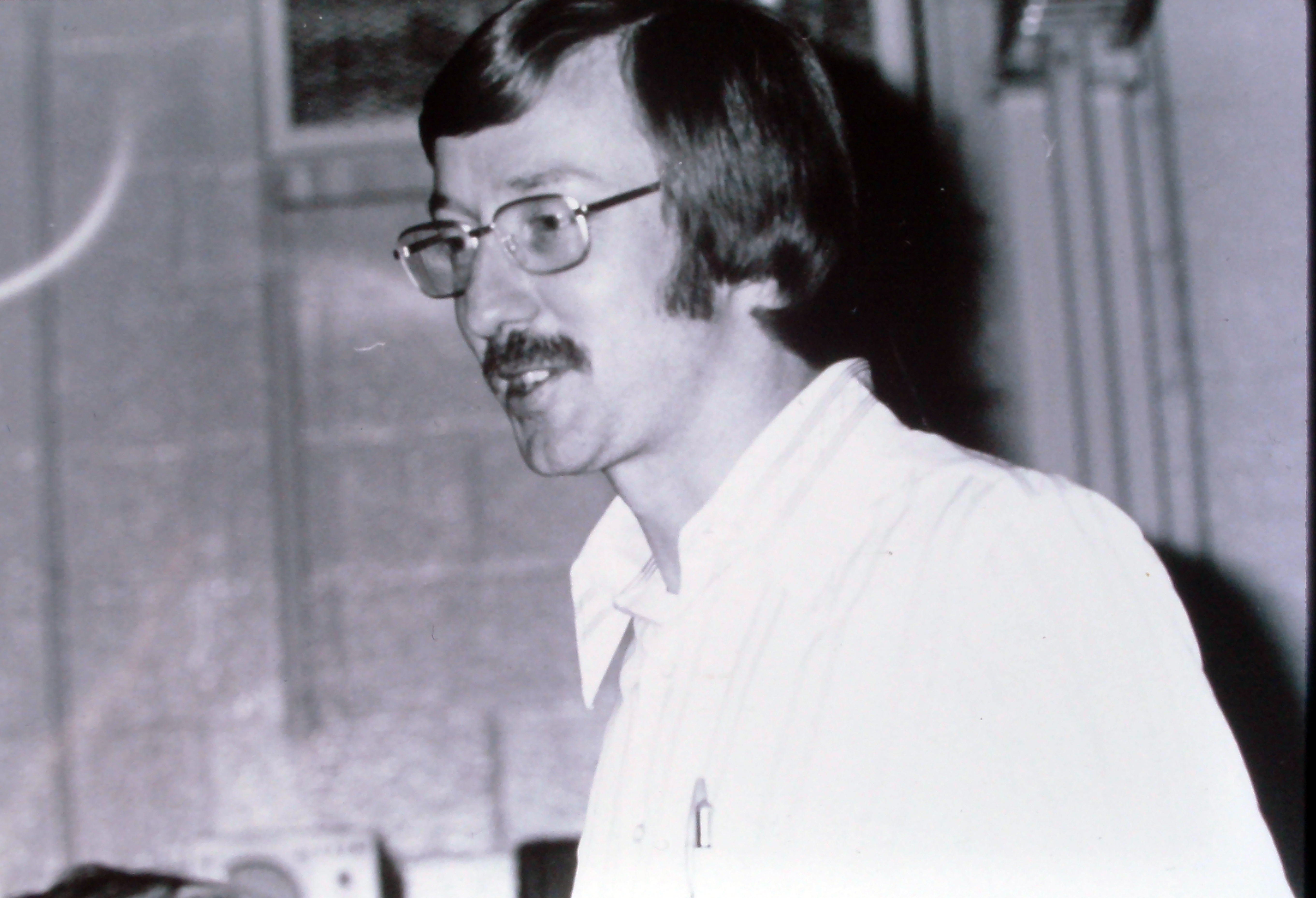
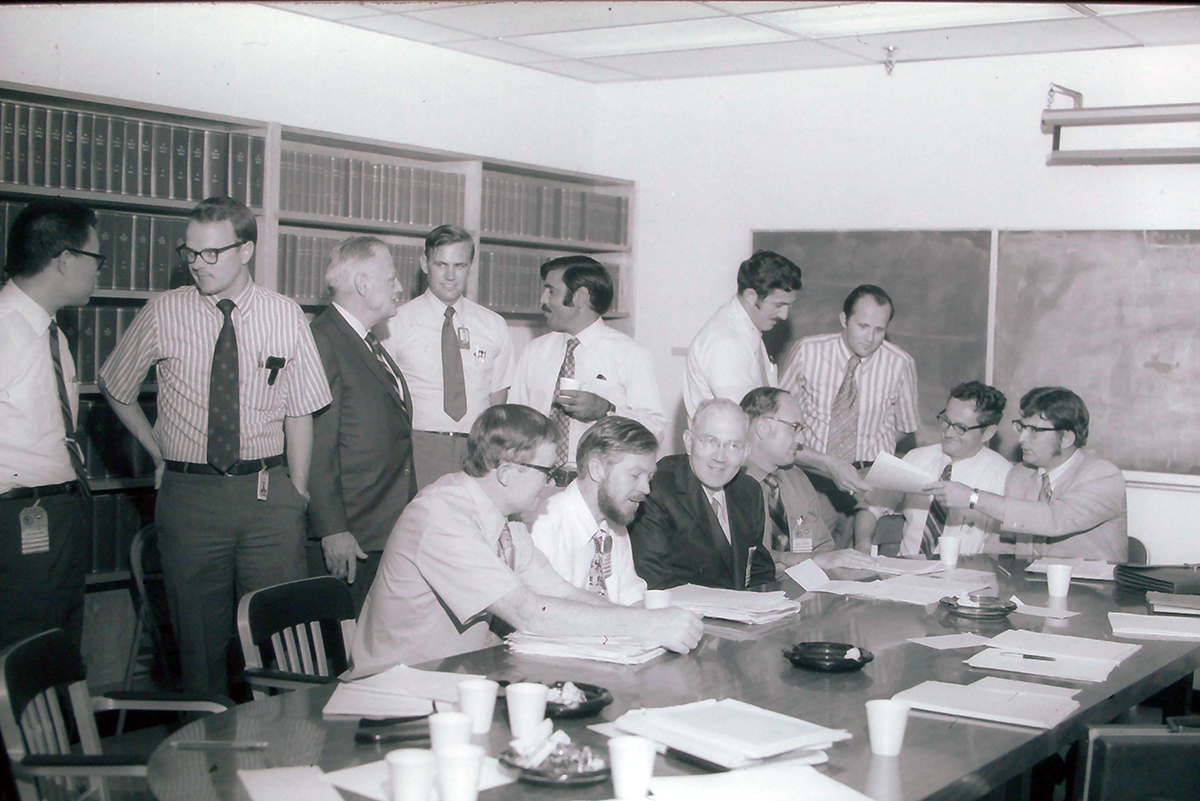
Lee Riedinger, Ph.D., pictured around the time he was involved in some of the UNISOR experiments through his work at UT.; Courtesy: Ken Carter
UNISOR made it easier for faculty at partner universities to get time to do experiments at the Oak Ridge cyclotron. Previously, they had to befriend a laboratory staff member convince him or her of your idea and get beam time that way. Researchers still had to compete for time at the cyclotron, but the scheduling process was managed by the UNISOR organization through ORAU.
ORAU has been and always will be an integral part of the scientific and technical workforce community in Oak Ridge and beyond. Riedinger said he looks forward to seeing how ORAU continues to make its mark in the years to come.